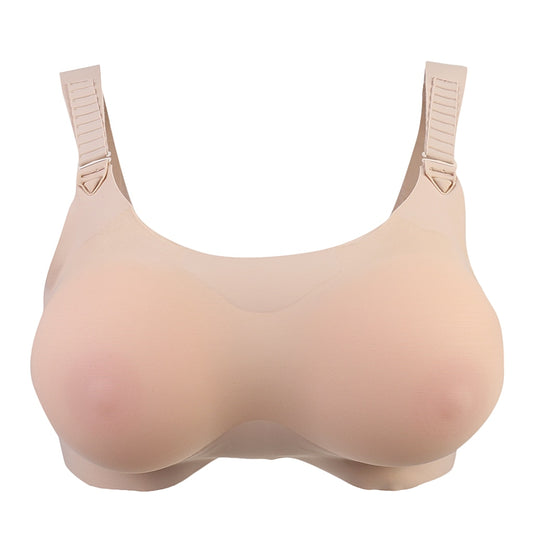

A silicone breastplate is one of the most powerful tools in a drag queen's arsenal — and one of the most misunderstood. It's not just a larger breast form. It's a completely different product that solves a specific problem: seamless décolletage with no visible edges at the neckline. This guide covers everything about breastplates — what they are, when to use them, how to apply them, and how to care for them.
For the complete guide to all breast form types including individual forms, sizing, and application, see our Complete Guide to Non-Medical Breast Forms.
What Is a Silicone Breastplate?
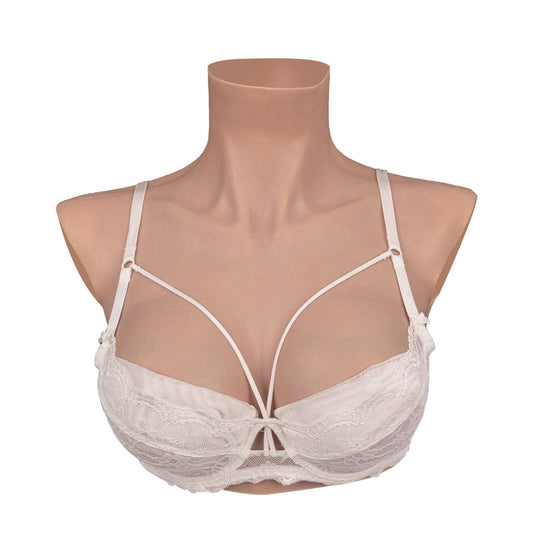
A silicone breastplate is a single-piece prosthetic that covers the entire chest and décolletage — from the collarbone down to the ribcage. Unlike individual breast forms, which are two separate pieces worn inside a bra, a breastplate is one continuous piece that creates a seamless skin-like surface across the entire chest area.
The defining feature is the high neckline: the breastplate extends up to the collarbone, eliminating the top edge that individual forms always have. This makes it the only option for truly seamless wear under sheer tops, very low-cut necklines, and open chest costumes where any edge would be visible.
Shop: High Neck Silicone Breastplate
When a Breastplate Is the Right Choice
A breastplate solves specific problems that individual forms can't. Choose a breastplate when:
- Sheer or mesh tops: Any edge from individual forms will be visible through sheer fabric. A breastplate's seamless surface eliminates this entirely.
- Very low-cut necklines: When the neckline drops below where individual forms would start, a breastplate's continuous surface is the only clean solution.
- Open chest panels: Costumes with sheer or open panels across the chest require a breastplate for a clean look.
- Pageant and glamour drag: Flawless décolletage with no visible edges is a pageant standard. A breastplate delivers this without edge blending work at the neckline.
- Photography and video: Camera lighting reveals edges that look invisible in a mirror. A breastplate eliminates neckline edge risk entirely for close-up photography.
- Minimal prep time: No edge blending at the neckline means less prep work for the décolletage area.
When Individual Forms Are Better
A breastplate is not always the right choice. Individual forms are better when:
- You want dramatic cup sizes (F cup and above) — breastplates are typically available in moderate cup sizes only
- You need cleavage control — individual forms let you position each form independently
- You need quick changes — breastplates require adhesive and take longer to remove
- Your costume has a covered neckline — if the top edge won't be visible, individual forms are simpler
For a full comparison, see our Breastplates vs Individual Forms guide.
How to Apply a Silicone Breastplate
Breastplates are applied with medical-grade adhesive — there's no pocket bra option for a full breastplate.
What You'll Need
- Medical-grade adhesive
- Isopropyl alcohol (70%+) and cotton pads
- Translucent setting powder and brush
- Adhesive remover or baby oil (for removal)
Step-by-Step Application
- Prep your skin: Clean the entire chest and décolletage area with isopropyl alcohol. Remove all traces of moisturizer, sweat, and oils. Allow to dry completely — at least 2 minutes.
- First adhesive coat: Apply a thin, even coat of adhesive to the back surface of the breastplate — the areas that will contact your skin. Focus on the edges and the center back. Allow to become tacky (30–60 seconds).
- Second adhesive coat: Apply a second thin coat. Allow to become tacky again. Two thin coats create a significantly stronger bond than one thick coat.
- Position carefully: Hold the breastplate against your chest without pressing to check positioning. The top edge should sit at or just below your collarbone. Once you press it down, repositioning is difficult.
- Press and bond: Press firmly from the center outward, working toward the edges. Hold firm pressure for 30–60 seconds across the entire surface.
- Seal the edges: Dust translucent setting powder around all edges where the breastplate meets your skin. This absorbs moisture and prevents sweat from working under the edges.
Edge Blending
The high neckline eliminates the top edge — the hardest edge to blend on individual forms. But the lower and side edges still need attention:
- Lower edge: Often concealed by the costume — a corset, high-waisted skirt, or decorative waistband covers the lower edge naturally.
- Side edges: Blend with body foundation or body paint matched to your chest skin tone. Work in thin layers and set with translucent powder.
- Setting powder baseline: Dust all edges with translucent powder before every performance as a minimum — this reduces shine differential and absorbs moisture.
Removal
Never pull a breastplate off dry. The surface area is larger than individual forms, which means more adhesive contact and more potential for skin irritation if removed incorrectly.
- Apply adhesive remover or baby oil generously around all edges.
- Allow 2–3 minutes for the remover to work under the edges and begin breaking down the adhesive bond.
- Gently lift one edge and apply more remover underneath as you go.
- Work slowly around the entire perimeter before attempting to remove the center.
- If you feel resistance anywhere, apply more remover and wait. Do not force it.
Care
The care routine for a breastplate is the same as for individual silicone forms, with one addition — the larger surface area requires more thorough cleaning and more powder to cover fully.
- Remove all adhesive residue from the back with adhesive remover after every use
- Wash with mild soap and lukewarm water — never hot water
- Pat dry with a soft cloth — never rub
- Dust the entire surface (front and back) with talcum powder once completely dry
- Store flat in the original packaging, away from heat and sharp objects
With proper care, a quality silicone breastplate lasts 3–5+ years.
Combining a Breastplate with Individual Forms
Some performers use a breastplate for the seamless neckline effect while wearing individual forms underneath or alongside for additional volume. The breastplate handles the décolletage; the individual forms add projection and size. This combination works particularly well for pageant drag and photography where every detail matters.
Shop
- High Neck Silicone Breastplate
- Individual Breast Forms — Shop by Size
- Corsets for Support & Waist Definition
For the complete guide to breast forms including all types, sizing, application, and care, read our Complete Breast Forms Guide.