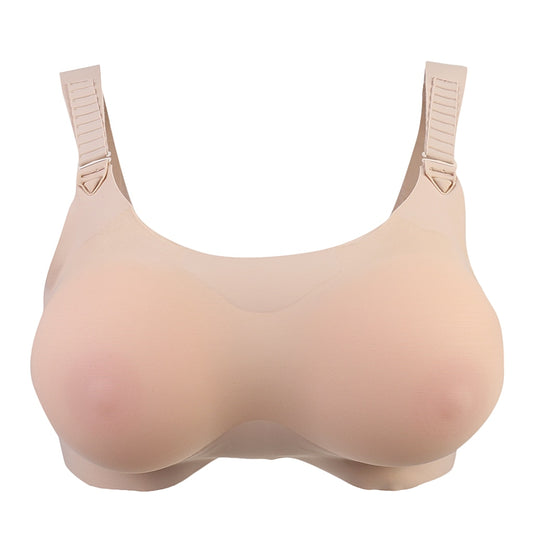

Skin tone mismatch is one of the most common issues with breast forms — and one of the easiest to fix once you know what to look for. Under stage lighting, a mismatch that looks subtle in a mirror can read as obvious from the audience. In photos, it's even more unforgiving. This guide covers how to choose the right tone, how to blend edges, and how to make forms disappear into your look.
For the complete guide to breast forms including types, sizing, and application, see our Complete Guide to Non-Medical Breast Forms.
Why Skin Tone Matching Matters
Silicone breast forms have a fixed skin tone built into the material. If that tone doesn't match your chest skin tone, the forms will be visible as a separate element — especially:
- Under stage lighting, which amplifies color differences
- In photography, where camera sensors pick up tone differences the eye misses
- Under sheer, mesh, or thin fabrics where the form surface is partially visible
- At the edges where the form meets your skin
Perfect matching isn't always possible — forms come in a limited range of tones. But with the right selection and blending techniques, you can make forms read as seamless in almost any context.
Step 1: Choose the Closest Available Tone
When selecting forms, compare the product images to your chest skin tone — not your face or hands, which are often different. Your chest is typically lighter than your face (less sun exposure) and may differ from your arms.
General guidance:
- Fair/light skin: Choose the lightest available tone. Silicone reads slightly warmer than it looks in product photos.
- Medium/olive skin: Mid-range tones. Check whether the form has pink or yellow undertones — match to your own undertone where possible.
- Deep/dark skin: Darker tones are less commonly available in standard ranges. Edge blending becomes more important when an exact match isn't available.
When in doubt, go slightly lighter rather than darker — lighter forms are easier to deepen with body paint or bronzer than dark forms are to lighten.
Step 2: Edge Blending Techniques
Even with a good tone match, the edge where the form meets your skin will always be the most visible area. These techniques minimize or eliminate visible edges:
Body Paint / Body Foundation
The most effective method. Apply a full-coverage body foundation or body paint that matches your chest skin tone over the form edges, blending outward onto your skin. Work in thin layers and set with translucent powder. This creates a seamless transition that reads as natural even under stage lighting.
Products to use: Full-coverage body foundation, alcohol-activated body paint, or heavy-coverage concealer. Avoid regular face foundation — it's not pigmented enough for body use and won't hold up under heat and movement.
Setting Powder
Dust translucent setting powder around the form edges. This reduces the shine differential between silicone (which has a slight sheen) and skin (which is matte). Even without color correction, reducing shine makes edges significantly less visible. This is a quick fix that every performer should do as a baseline.
Fishnets & Mesh Overlays
Fishnets and mesh fabrics naturally break up edge lines. A fishnet bodysuit or mesh overlay worn over forms makes edges almost invisible — the pattern draws the eye away from the transition. This is a practical technique for performers who don't want to spend time on body paint.
Strategic Costume Design
Design or choose costumes that cover the form edges with fabric, trim, embellishment, or ruching. A costume with a decorative band across the chest at the level of the form edges eliminates the blending problem entirely. This is the approach many experienced drag queens use — design around the forms rather than trying to hide them.
Bronzer & Contouring
If your forms are slightly lighter than your chest, apply a light dusting of bronzer over the form surface to warm the tone. Blend outward onto your skin. This works best for small tone differences — it won't bridge a large mismatch but can close a gap of one or two shades.
Stage Lighting Considerations
Stage lighting changes everything. Warm amber and pink stage lights make skin tones warmer and can make lighter forms read as more natural. Cool blue or white lights are more unforgiving and amplify tone differences.
Test your forms under similar lighting to your performance environment before the show. What looks seamless in your bathroom mirror may look different under stage lights. If possible, do a lighting check with your forms in place before the audience arrives.
Photography & Content Creation
Camera sensors are more sensitive to tone differences than the human eye. For photography:
- Always use body foundation or body paint over form edges — setting powder alone is rarely enough for close-up photography
- Shoot in warm lighting where possible — it's more forgiving of tone differences
- Consider the high-neck breastplate for photography — it eliminates the top edge entirely, which is the most visible edge in photos
- Post-processing can correct minor tone differences, but it's easier to get it right in camera
The Breastplate Solution
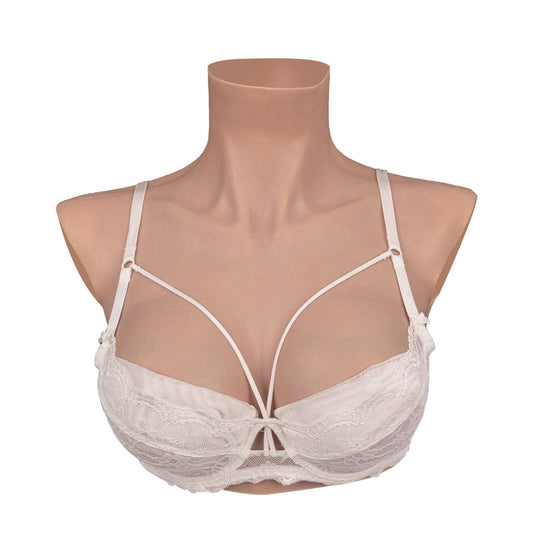
If skin tone matching is a persistent challenge for your look, a high-neck silicone breastplate eliminates the top edge entirely. The breastplate extends to the collarbone, so there's no visible edge at the neckline — the most difficult edge to blend on individual forms. You still need to blend the lower and side edges, but the neckline is handled.
Quick Reference: Edge Blending by Situation
| Situation | Best Approach |
|---|---|
| Stage performance, covered neckline | Setting powder on edges + bronzer if needed |
| Stage performance, sheer/low-cut top | Body foundation + setting powder, or breastplate |
| Photography / content creation | Body foundation blended over all edges |
| Fishnet or mesh costume | Fishnet overlay naturally breaks up edges |
| Quick change / no prep time | Setting powder + costume design to cover edges |
Shop
- All Breast Forms — Shop by Size
- High Neck Breastplate — eliminates top edge
- Pocket Bra for Breast Forms
For the complete guide to breast forms including sizing, application, performance tips, and care, read our Complete Breast Forms Guide.