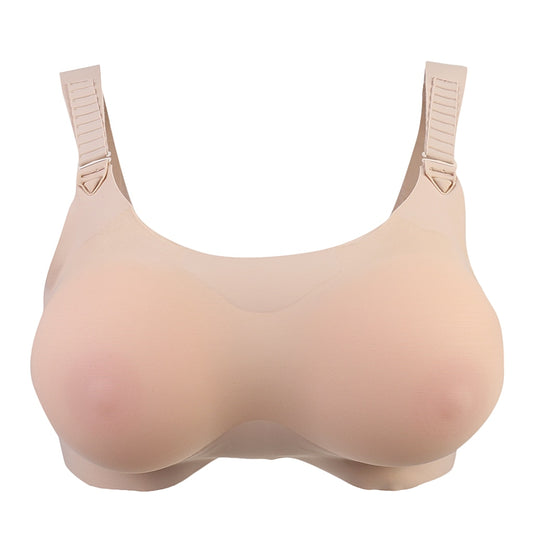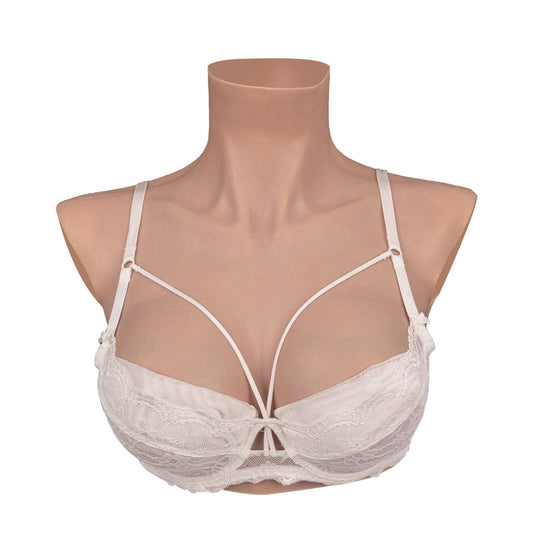

Standard bra sizing charts are designed for cisgender women — they assume a chest shape, rib cage proportion, and breast root width that doesn't apply to most AMAB bodies. If you've tried to use a standard sizing chart and ended up with forms that sit wrong, gap at the sides, or look disproportionate, this is why.
This guide gives you the actual sizing system that works for AMAB bodies — measurements, calculations, frame-based recommendations, and the adjustments that make the difference between forms that look placed and forms that look natural. For the complete guide to breast forms including types, application, and care, see our Complete Guide to Non-Medical Breast Forms.
Why Standard Sizing Charts Don't Work for AMAB Bodies
Three key anatomical differences affect how breast forms fit on AMAB bodies:
- Wider chest wall: AMAB bodies typically have a wider distance between the breast roots, meaning forms need to be positioned differently to avoid looking too far apart or too close together.
- Flatter chest surface: Without existing breast tissue, forms sit on a flatter surface — which affects how they project and how the edges blend.
- Different rib cage shape: AMAB rib cages are typically more cylindrical, which affects how bra bands fit and how forms sit at the sides.
The result: a size that looks natural on a cisgender woman may look too small, too large, or incorrectly positioned on an AMAB body. The system below accounts for these differences.
Step 1: Take Your Measurements
You need two measurements. Use a soft measuring tape and measure in inches.
Underbust Measurement
Measure around your ribcage directly under where your bust will sit — at the level of the bottom of your sternum. Keep the tape parallel to the floor and snug but not tight. This is your underbust measurement.
Desired Overbust Measurement
This is where AMAB sizing differs from standard charts. Rather than measuring existing breast tissue, you're deciding what overbust measurement you want to achieve. Measure around the fullest part of your chest at the level where the forms will project — typically across the nipple line.
If you're unsure what overbust to aim for, use the frame guide below to get a starting recommendation, then adjust based on your aesthetic goals.
Step 2: Calculate Your Band Size
Your band size determines which bra size you need for a pocket bra.
- If your underbust measurement is even: add 4 inches → that's your band size
- If your underbust measurement is odd: add 5 inches → that's your band size
Example: Underbust = 34" (even) → Band size = 38
Step 3: Calculate Your Cup Size
Subtract your band size from your desired overbust measurement. Each inch of difference = one cup size:
| Difference | Cup Size |
|---|---|
| 1" | A |
| 2" | B |
| 3" | C |
| 4" | D |
| 5" | E (DD) |
| 6" | F (DDD) |
| 7" | G |
| 8" | H |
| 9"+ | S / Plus |
Example: Band size 38, desired overbust 43" → difference = 5" → E cup → Size: 38E
AMAB Frame Sizing Guide
If you're not sure what size to aim for, use this frame-based guide as a starting point. These recommendations are calibrated for AMAB body proportions — not standard women's sizing charts.
| Frame | Underbust | Natural Everyday Look | Stage / Dramatic Drag |
|---|---|---|---|
| Petite / slim | 28–32" | B–C | D–F |
| Average | 33–36" | C–D | E–G |
| Athletic / broad | 37–40" | D–E | F–H |
| Plus / full | 41"+ | D–F | G–S+ |
Stage Sizing Note
Under stage lighting, forms read smaller than they look in a mirror at home. For stage performance, size up 1–2 cups from what looks natural in a mirror. What looks dramatic at home reads as natural from 30 feet away under stage lights.
Shoulder Width Adjustment
Broader shoulders can carry larger forms proportionally. If your shoulder width is significantly wider than average (typically 18"+ across), you can size up one cup from the frame guide above without the forms looking disproportionate. Narrower shoulders should stay at the lower end of the recommended range.
The Silhouette Balance Rule
Breast forms alone don't create a convincing feminine silhouette — proportion matters. The classic hourglass ratio is bust ≈ hips, with a defined waist in between.
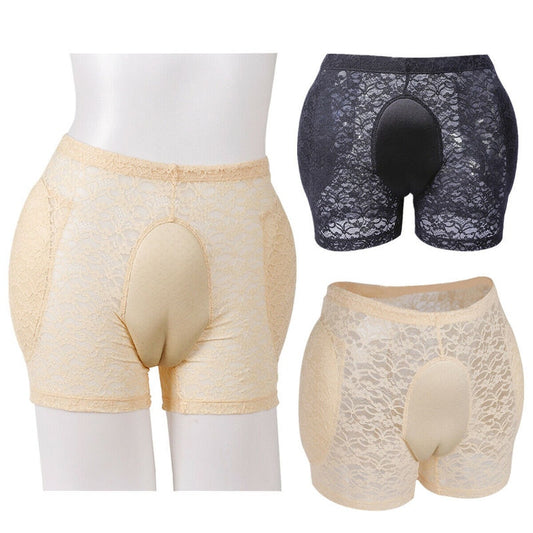
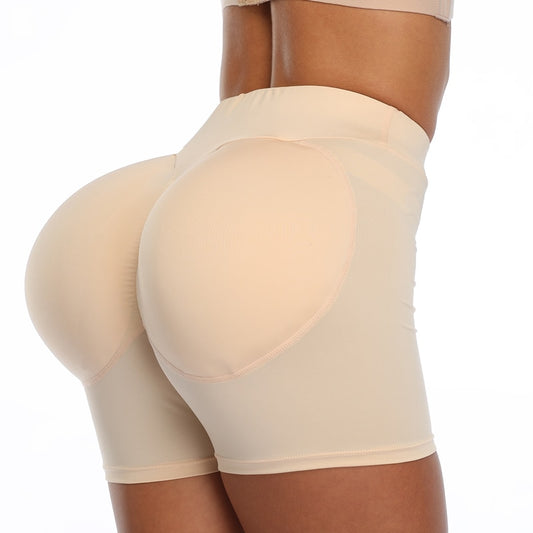
As a practical guide: your hip measurement (with hip and butt padding) should be roughly equal to or slightly larger than your bust measurement. If you're wearing D cup forms, aim for hip padding that brings your hip measurement to at least your bust measurement. A top-heavy silhouette without matching hip proportion reads as unbalanced on stage.
Common Sizing Mistakes
- Using a women's sizing chart directly: These assume existing breast tissue and different chest geometry. Always use the AMAB calculation above.
- Choosing size based on how forms look in photos: Photos are taken on different body types. Use measurements, not visual comparison.
- Ignoring band size: A correctly sized cup in the wrong band size won't fit properly. Band fit is as important as cup size.
- Not accounting for stage sizing: Forms that look perfect in a mirror at home will read as smaller on stage. Size up for performance.
- Skipping hip proportion: Large bust without matching hip padding creates a top-heavy look that doesn't read as feminine from a distance.
Shop by Cup Size
Browse our full silicone breast forms collection by cup size:
- A Cup Silicone Breast Forms
- B Cup Silicone Breast Forms
- C Cup Silicone Breast Forms
- D Cup Silicone Breast Forms
- E Cup Silicone Breast Forms
- F Cup Silicone Breast Forms
- G Cup Silicone Breast Forms
- H Cup Silicone Breast Forms
- S Cup Silicone Breast Forms
Also available: Pocket Bra for Breast Forms · Hip & Butt Padding
For the complete breast forms guide including types, application methods, performance tips, and care, read our Complete Breast Forms Guide.